


百思不得姐
Chinese, Belarusian airborne troops launch Swift Eagle drill_我的网站

一 | WASHINGTON -- Millions of Social Security recipients will get a 3.2% increase in their benefits in 2024, far less than this year's historic boost and reflecting moderating consumer prices.The cost-of-living adjustment, or COLA, means the average recipient will receive more than $50 more every month beginning in January, the Social Security Administration said Thursday. The AARP estimated that increase at $59 per month. “This will help millions of people keep up with expenses,” said Kilolo Kijakazi, Social Security’s acting commissioner.About 71 million people — including retirees, disabled people and children — receive Social Security benefits. Thursday's announcement follows this year’s 8.7% benefit increase, brought on by record 40-year-high inflation, which pushed up the price of consumer goods. With inflation easing, the next annual increase is markedly smaller.“Compared to last year's 8.7% increase, this is going to feel small and the perception is that its not keeping up with the inflation and the higher costs that retirees are still seeing,” said Martha Shedden, president of the National Association of Registered Social Security Analysts.On top of that, an anticipated increase in Medicare premiums for 2024 will eat into the Social Security cost-of-living bump.Medicare hasn’t announced the increase for traditional Medicare, but said the cost of Medicare Advantage plans is expected to remain stable.Still, senior advocates applauded the annual Social Security adjustment.“Retirees can rest a little easier at night knowing they will soon receive an increase in their Social Security checks to help them keep up with rising prices,” AARP CEO Jo Ann Jenkins said. “We know older Americans are still feeling the sting when they buy groceries and gas, making every dollar important." Social Security is financed by payroll taxes collected from workers and their employers. The maximum amount of earnings subject to Social Security payroll taxes will be $168,600 for 2024, up from $160,200 for 2023. Retirees whose sole income comes from Social Security are not subject to taxes on that income.Nancy Altman, president of Social Security Works, an advocacy group for the social insurance program, said that the COLA is a “reminder of Social Security’s unique importance" and that “Congress should pass legislation to protect and expand benefits.”However, the program faces a severe financial shortfall in the coming years.The annual Social Security and Medicare trustees report released in March said the program’s trust fund will be unable to pay full benefits beginning in 2033. If the trust fund is depleted, the government will be able to pay only 77% of scheduled benefits, the report said.There have been legislative proposals to shore up Social Security, but they have not made it past committee hearings.A March poll by The Associated Press-NORC Center for Public Affairs Research found that most U.S. adults are opposed to proposals that would cut into Medicare or Social Security benefits, and 79% of people polled said they oppose reducing the size of Social Security benefits.The Social Security Administration is still without a permanent leader. President Joe Biden in July nominated former Maryland Gov. Martin O’Malley to lead the agency.The COLA is calculated according to the Bureau of Labor Statistics’ Consumer Price Index, or CPI. But there are calls for the agency to instead use a different index, the CPI-E, which measures price changes based on the spending patterns of the elderly, like health care, food and medicine costs.Any change to the calculation would require congressional approval. But with decades of inaction on Social Security and with the House at a standstill after the ouster of Speaker Kevin McCarthy, R-Calif., seniors and their advocates say they don’t have confidence any sort of change will be approved soon. The cost of living adjustments will have a big impact on people like Alfred Mason, an 83-year-old Louisiana resident. Mason said that “any increase is welcomed, because it sustains us for what we are going through.”As inflation is still high, he said, anything added to his income “would be greatly appreciated.”。
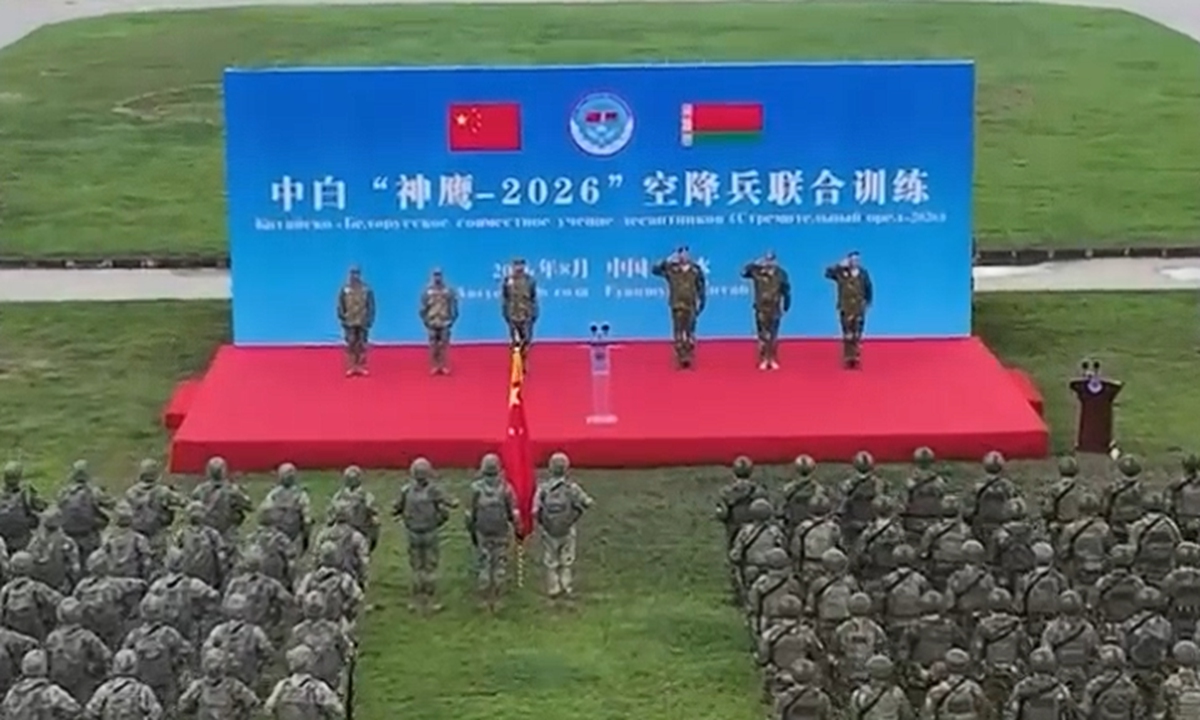
Focusing on "joint counter-terrorism operations in urban terrain," the training will focus on subjects such as surveillance and counter-surveillance, seizure-and-control and protection, and elimination and defense, Xinhua reported.
In addition, the two sides will organize seminars, friendly football matches and cultural exchange activities during the joint training, said the report.
As the fourth iteration, the joint training will help enhance the combat capabilities of the participating troops and deepen substantive cooperation between the two militaries, said Xinhua.
While details on the equipment deployed by both sides have not yet been disclosed, Wang Yanan, editor-in-chief of Beijing-based Aerospace Knowledge magazine, told the Global Times on Thursday that Belarus is likely to follow its traditional practices, focusing on low-altitude small-scale airborne operations, possibly using Il-76 large transport aircraft, while China may deploy Y-9 or Y-20 transport aircraft for low-altitude delivery.
The joint training is not a one-way learning exercise, but rather a process of building a cooperative foundation and familiarizing both sides with each other's operational habits in the counter-terrorism domain, Wang said.
While China has made significant progress in counter-terrorism and maintaining stability in recent years, the expert said, airborne troops have been rarely used in counter-terrorism operations, as local police and armed police forces are generally sufficient to handle such situations.
Airborne troops are better suited for special counter-terrorism scenarios, such as large-scale counter-terrorism operations or cases where terrorists have occupied urban building complexes and need to be forcibly removed. This joint training likely simulates such scenarios, Wang said.
The previous iteration of the Swift Eagle series airborne joint counter-terrorism training between China and Belarus took place in 2015.
In June 2015, a PLA Air Force spokesperson announced that China had dispatched an airborne special operations detachment to Belarus to participate in the Swift Eagle 2015 joint counter-terrorism training.
According to China Military Online, the training followed the 2011 and 2012 joint exercises between the two countries' airborne forces, again focusing on joint counter-terrorism operations.
The spokesperson noted that Belarus is a traditional friendly country to China.
Conducting joint airborne training with Belarus helps consolidate traditional bilateral friendship, deepen practical exchanges and cooperation between the two militaries, and enrich the content of the comprehensive strategic partnership between the two countries.
Wang noted that Belarus, located to China's west, and China share a common long-term interest in discussing counter-terrorism.
After a hiatus of several years, the resumption of the Swift Eagle joint training provides an opportunity to promote in-depth cooperation in defense and mutual trust, serving as a point of common interest for both sides.
Wang noted that the PLA's domestic training exercises have undergone profound changes in recent years.
For example, the documentary series Zhìshèng (Victory) broadcast in early August, showed training conducted with a no-script model, with both sides engaging in free-form confrontations and evaluating results based on actual combat performance, promoting the integration of personnel and equipment systems to generate new operational capabilities. This model has already produced notable results.
More broadly, Wang said, recent joint exercises between the PLA Air Force and foreign militaries have yielded multiple benefits, primarily on two levels.
First, they lay the groundwork for potential future joint operations, whether in counter-terrorism, maintaining stability or major international security issues, as mutual familiarity is essential for effective cooperation.
Second, joint exercises themselves contribute to regional stability. When friendly countries in the region reach consensus on security issues and conduct regular military cooperation, it has a stabilizing effect on regional security.
Overall, the PLA is building a more open and flexible military cooperation framework through both enhanced domestic combat-oriented training and expanded international joint exercises, Wang said.
。
Current article:http://www.xuanliaruamibinmilangca.shop/2q6ns/uxou.html
Published on:19:28:05