留守儿童
Grassroots official’s 30-year fight against desertification in North China_我的网站

一 | Drones zip across city blocks, delivering meals to doorsteps. On factory floors, humanoid robots are put to the test. Streets buzz with electric vehicles, and artificial intelligence (AI) is woven ever deeper into manufacturing, healthcare and urban services. When China hosts the 33rd APEC Economic Leaders' Meeting in Shenzhen this November, delegates will gather in a city that has become one of the country's leading centers for emerging industries. It will be China's third time hosting the event, following Shanghai in 2001 and Beijing in 2014. Adjacent to Hong Kong, Shenzhen in Guangdong Province was one of China's first special economic zones and has evolved over the past four decades into a global hub for innovation and advanced manufacturing. It is home to tech heavyweights such as Huawei, Tencent, BYD, DJI, and UBTECH, along with a vibrant community of startups spanning sectors from AI to new energy. In the first half of 2026, the city's trade with other APEC economies rose 33 percent to 1.98 trillion yuan (about 291.6 billion U.S. dollars), accounting for 68.8 percent of its total foreign trade. Today, Shenzhen offers a window into China's new growth drivers and their potential to create new opportunities across the Asia-Pacific region. LOW-ALTITUDE ECONOMY Official data show that around 70 percent of China's consumer drones and half of its industrial drones are produced in Shenzhen, home to leading manufacturers including DJI. Shenzhen is also a testing ground for commercial drone applications, from logistics and emergency response to power-grid inspection. Food-delivery giant Meituan opened its first drone-delivery route to customers in Shenzhen years ago. By the end of June 2026, its drones were delivering orders from over 1,500 merchants, including KFC, McDonald's and Chinese tea chain Chagee. To support the industry's growth, Shenzhen has built more than 1,200 low-altitude takeoff and landing facilities and opened 310 logistics routes. Cargo drones completed more than 1 million flights in 2025, up 29 percent from a year earlier. Shenzhen has also led the way in regulation. In 2019, it became the first city in China to introduce local legislation specifically for the management of civilian light and micro drones. NEW ENERGY VEHICLES Shenzhen has emerged as one of China's leading hubs for new energy vehicles (NEVs), backed by strong innovation capabilities and one of the country's most complete industrial ecosystems spanning lithium battery materials, energy storage integration and end-use applications. One of the best-known companies benefiting from this ecosystem is BYD, headquartered in Shenzhen. The automaker sold around 2.26 million electric vehicles (EVs) in 2025, surpassing Tesla in global EV sales last year. Its NEVs are now available in 119 countries and regions. The city is also home to more than 1,400 intelligent-driving companies. Shenzhen is investing heavily in charging infrastructure. In 2023, it launched a drive to become a "city of superchargers," and by 2024, supercharging facilities outnumbered conventional petrol stations. So far, it has built more than 1,200 ultra-fast charging stations with charging power of 480 kilowatts or above. ROBOTS AND AI Last year, a robot 6S store, claimed to be the world's first of its kind, opened in Shenzhen and quickly became a local sensation. Shenzhen has fostered a new generation of robotics companies, including UBTECH, Honor and Leju Robot. By the end of 2025, the city was home to 34 listed robotics companies and nine unicorns. The sector expanded rapidly last year. Humanoid robot production surged 83.1 percent year on year to 343,400 units, while the total robotics industrial output value in the city exceeded 240 billion yuan, up over 20 percent year on year. Shenzhen has more than 2,600 major AI companies, with an industry spanning AI chips, algorithm frameworks and foundation models as well as software and hardware applications. AI-enabled smartphones, translation earbuds, smart glasses and smart toys made in Shenzhen are increasingly reaching both domestic and overseas markets. 
 。
。
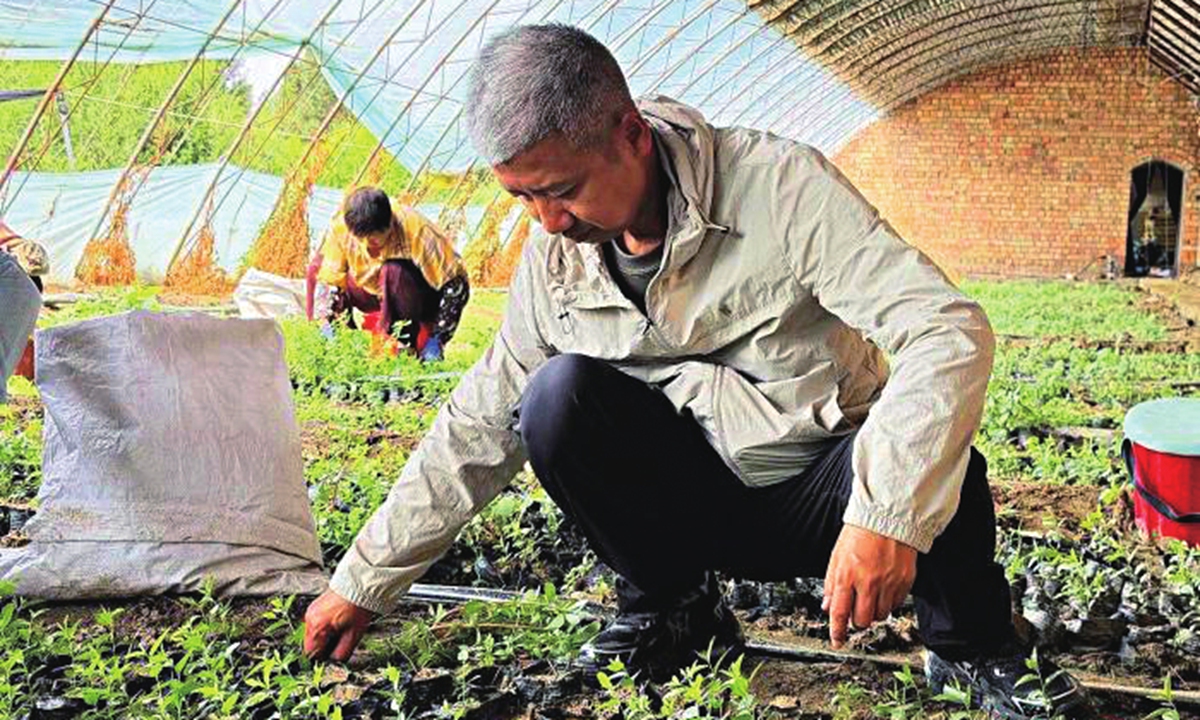
Wensuyalatu checks the growth of sour jujube seedlings. Photos: Chinanews.comAcross the vast desert landscape of the Urad Rear Banner in North China's Inner Mongolia Autonomous Region, one grassroots official has spent more than three decades turning barren sands into patches of green.
Ecological restorationFor over 30 years, Wensuyalatu, a member of the leadership group of the Urad Rear Banner forestry and grassland bureau, has made the Gobi Desert his workplace, dedicating his life to combating desertification, advancing ecological restoration through technological innovation, and helping local herders increase their incomes, according to the local bureau's official WeChat account.
Located on the edge of the desert in Bayannur's Urad Rear Banner, it is a key area in China's Three-North Shelterbelt Forest Program, a major ecological project aimed at strengthening the country's northern ecological security barrier.
However, early afforestation efforts in the desert were far from easy at the start.
The project covers 103,800
mu (about 6,920 hectares), including comprehensive treatment of 24,500
mu of desertified land, ecological restoration of 4,100
mu of non-desertified land, and 75,200
mu of enclosed grassland restoration. The project also includes the construction of 11 small-scale water conservation facilities, all of which required strict standards and extensive coordination.
The project also includes the construction of 11 small-scale water conservation facilities, all of which required strict standards and extensive coordination.
In 1991, Wensuyalatu, then in his early 20s, chose to devote himself to forestry and grassland conservation in the Urad Rear Banner. Since then, he has remained on the front lines of desertification control, witnessing the region's harshest environmental challenges and working to find solutions adapted to the fragile desert ecosystem.
In the early years, afforestation in the Gobi Desert was an extremely difficult task. The most critical planting season in spring often coincided with the strongest sandstorms of the year. Every year during the key afforestation period, Wensuyalatu would stay deep in the desert, guiding workers on planting techniques and management practices, while carefully overseeing every detail of the ecological restoration projects.
"Every spring, the wind and blown sand were so strong that it was hard to keep your eyes open. The sand hit your face like needles. During the day, we followed workers to dig holes and plant trees, and at night we stayed in temporary shelters to organize data and review the day's work. That was the normal routine for desertification fighters," Wensuyalatu recalled.
The road to restoring the desert was far from easy. Years of drought, low survival rates of seedlings, and skepticism from some local residents created major obstacles.
"At the beginning, it was really difficult. The climate was extremely dry, and many seedlings died after being planted. Some herders did not understand or support the work. They believed deserts were naturally barren and that no amount of effort could make trees grow there," Wensuyalatu said.
To change these perceptions, Wensuyalatu brought local residents to see firsthand the damage caused by desert expansion. Through visible results and long-term communication, he gradually won the understanding and support of the community.
Facing the ecological challenges of the Urad Rear Banner, Wensuyalatu began exploring new approaches beyond traditional restoration methods.
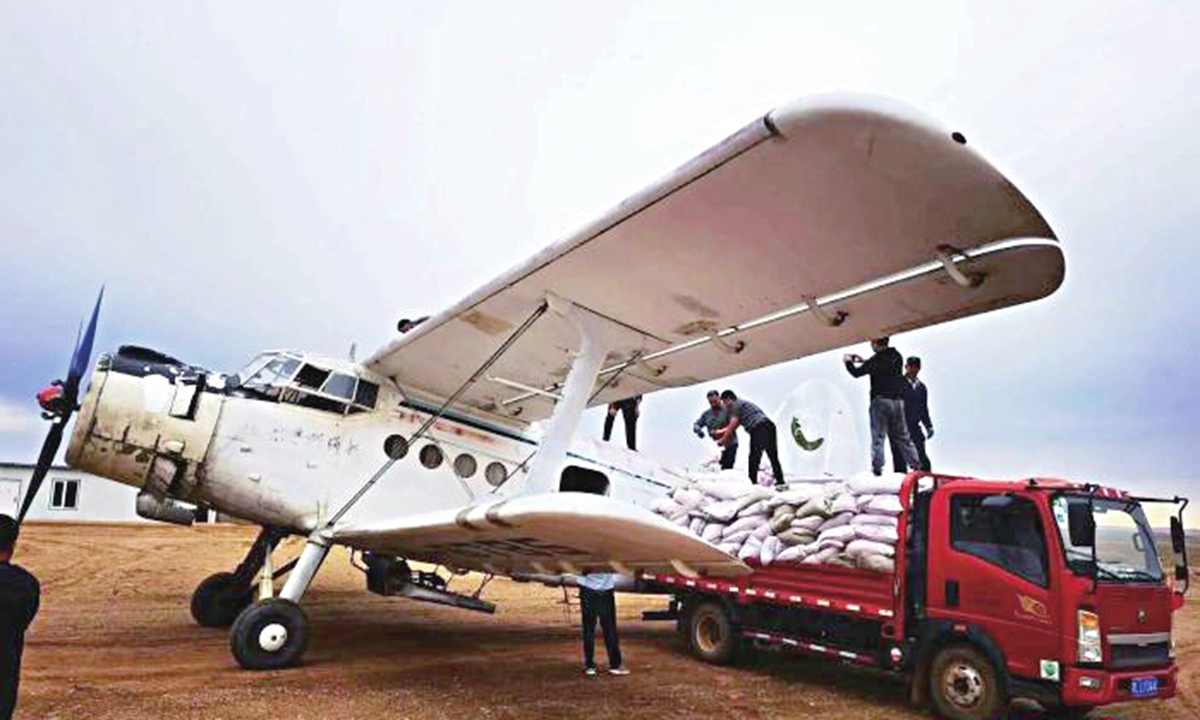
Staff members get ready to carry out aerial seeding operations.
Aerial seedingSince 2004, he has led efforts to tackle desert restoration challenges by introducing large-scale aerial seeding projects, creating a breakthrough approach for restoring degraded desert ecosystems in the region.
"Compared with traditional methods, aerial seeding is more efficient and can cover wider areas. Based on local climate and soil conditions, we select suitable desert plant seeds and precisely control the seeding height, density and timing to improve survival rates as much as possible and accelerate desert recovery," Wensuyalatu explained.
After years of effort, the aerial seeding projects under Wensuyalatu's leadership have restored more than 800,000
mu of desert land, with an effective restoration rate of 62.2 percent.
He also developed an integrated management approach combining "protection, management, retreat, restoration and publicity," establishing a mixed vegetation system of trees, shrubs and grass to curb desert expansion and reduce sandstorms at their source.
Beyond restoring greenery, Wensuyalatu has also focused on strengthening scientific research and protecting native desert species.
Starting in 2010, he devoted himself to the artificial cultivation of endangered native desert plants. After more than a decade of repeated experiments, he successfully developed cultivation techniques for rare species such as the endangered evergreen broadleaf shrub
Ammopiptanthus mongolicus, Mongolian almond and drought-resistant elm.
Under his leadership, his team cultivated 6.5 million seedlings and completed more than 4,000
mu of high-quality afforestation projects, with seedling survival rates consistently exceeding 80 percent.
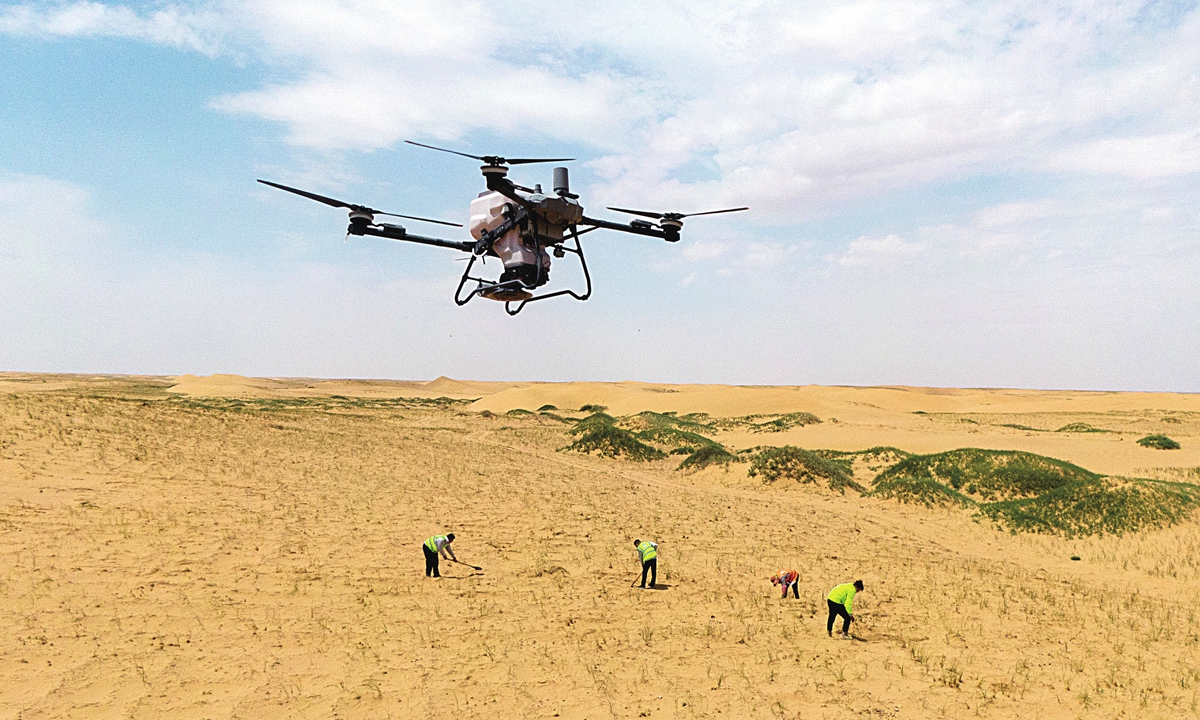
Engineering personnel operate drones to conduct aerial seeding as part of afforestation efforts in the Badain Jaran Desert in North China on June 17, 2025. Photo: VCGHis achievements filled a technological gap in large-scale cultivation of native desert plants and earned him second prize in the 2017 Inner Mongolia Autonomous Region Harvest Award.
For Wensuyalatu, desert restoration is not only about creating ecological benefits, but also about improving people's livelihoods.
He has long promoted the idea that "trees should bring both ecological value and economic value." By leveraging local desert resources, he helped establish a 10,000-
mu industrial base for desert plants and cistanche - a medicinal plant often grown in desert environments - across four key local villages, integrating ecological restoration with specialty desert industries.
"In the past, people thought desertification control was simply about planting trees - it took a lot of efforts but brought little income. Now things are different. By planting trees and developing industries such as cistanche cultivation, desert land can generate real wealth," a local herder said.
To ensure that local communities benefit from ecological development, Wensuyalatu introduced enterprises, supported family forest farms and professional cooperatives, and promoted large-scale, market-oriented operations.
The once barren desert has gradually become a "green treasure chest" for local herders, achieving a win-win outcome: greener landscapes, improved ecosystems, stronger businesses and higher incomes.
"Desertification control is not just an ecological project, but also a project that benefits people," Wensuyalatu said.
"Only when communities gain real benefits from protecting nature will they actively participate in ecological conservation. That is the key to making restoration efforts sustainable and achieving the vision that lucid waters and lush mountains are invaluable assets," Wensuyalatu said.
Global Times
。
Current article:http://www.xuanliaruamibinmilangca.shop/925j3kp/nfzko.html
Published on:19:57:59


 。
。 